- Home
- Logistics property: what matters
- Defence and logistics real estate
Insights
Defence and logistics real estate.
More budget, more materiel, more stockpiling. Defence is becoming a demand driver in its own right for warehouse, production and service space in Germany. What occupiers need, what owners should know and where the limits are.
From budget to building
Since 2022 the security situation in Europe has changed fundamentally. Germany is raising defence spending significantly, has exempted spending above one per cent of GDP from the constitutional debt brake and has committed to new NATO spending targets. A large share of this money goes into materiel, ammunition, spare parts and infrastructure, all of which has to be produced, stored, maintained and moved.
This creates demand the logistics property market has rarely seen: occupiers with very long planning horizons, high security requirements and often sovereign credit quality. At the same time, much of the need is met on the occupiers' own or federal land. For the open market, the question is therefore not the headline figure but how much space will actually be leased or bought, and which buildings qualify.
Key points
- Germany's 2026 defence budget, including the special fund, exceeds EUR 108 bn. The ministry plans to reach NATO's 3.5% core target by 2029.
- In a NATO contingency Germany is the hub for moving allied forces. Handling, staging, refuelling and maintenance rely on civilian logistics capacity.
- Market studies expect lasting additional demand for space, but only part of it will be leased on the market. A large share is built by the state and industry for their own use.
- Demand focuses on warehousing and distribution, production halls, maintenance and dual-use buildings with good alternative use.
- Security, classified-information rules, power and location are decisive. Ammunition and explosives storage are special-purpose facilities with their own legal framework, not standard warehouses.
This article provides a general overview and does not replace legal, tax or security advice in individual cases. Figures and legal position as of November 2026.
01
The political and financial framework
The new demand rests on binding budget decisions, a constitutional amendment and commitments within NATO. The key figures:
- 108bn
- euros of defence spending in 2026 including the armed forces special fund, adopted by the Bundestag in November 2025.
- 5%
- of GDP as NATO target for 2035: 3.5% for core defence, 1.5% for infrastructure, resilience and the industrial base.
- 260,000
- active service members targeted by 2035, plus 200,000 reservists, under the military service act in force since 2026.
- 800,000
- allied troops could transit Germany within around six months in a contingency, according to media reports on Germany's operational plan.
Sources: Federal Ministry of Defence, Federal Government, NATO Hague Summit Declaration 2025, media reports on the Operational Plan Germany. The 2027 government draft provides around EUR 110 bn for the defence budget; parliament has not yet adopted it.
02
Why defence needs logistics space
Armed forces are to a large extent logistics organisations. Every new vehicle, weapon system and ammunition order brings warehousing, spare-parts supply, maintenance and transport with it. For years this backbone was reduced: depots were closed, sites converted and stocks cut to the minimum.
Today the logic is reversed. Just-in-case replaces just-in-time. Stocks are to be built up and quickly available, supply chains made more resilient and more production brought back to Europe. Germany's geography adds to this.
Germany as the alliance's hub
Germany's operational plan describes how allied forces would move through the country to NATO's eastern flank. This involves handling at ports and rail lines, rest and staging areas, refuelling, catering and repair. Much of it is provided by civilian partners under framework contracts, for example in rail, motorways and logistics services. At EU level, military mobility along designated corridors is being expanded.
What this means for real estate
- Additional warehouse and distribution space for clothing, equipment, spare parts and consumables.
- Production and assembly halls for manufacturers and suppliers expanding capacity.
- Maintenance and service with workshops, test benches and crane runways.
- Handling and staging areas at ports, rail terminals and motorway junctions.
- Light industrial and technology space for sensors, drones and software with high power demand.
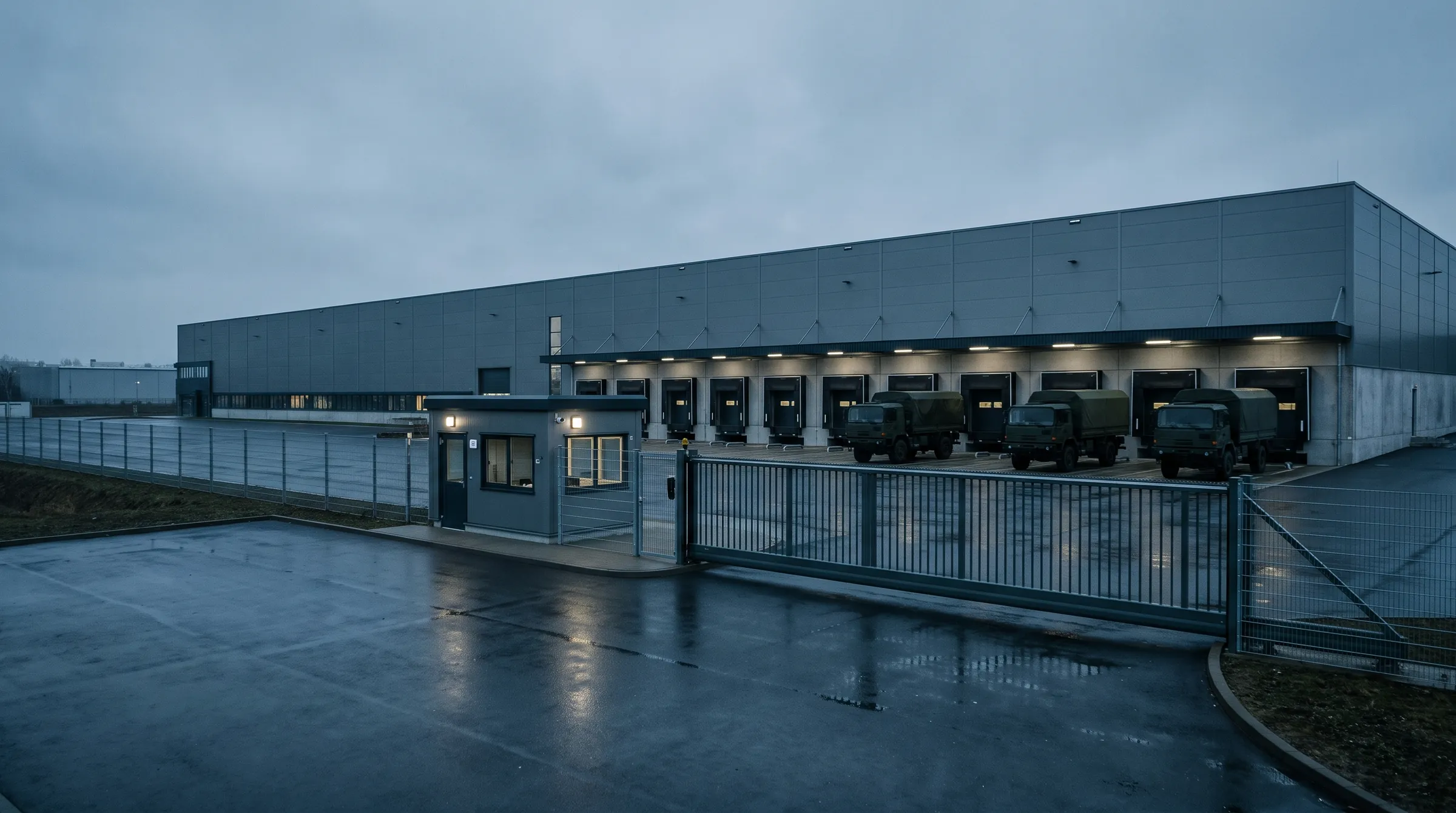
 AI-generated
Defence
Just in case instead of just in time.
03
Who is looking for space
Demand does not come from a single player but from several groups with very different requirements.
Armed forces and federal agencies
Central warehouses for clothing and equipment, spare-parts logistics and depots, often via long leases or developments with a lease, complemented by federal sites.
Defence manufacturers
New plants, assembly and test halls, logistics centres for components. Large manufacturers often build themselves but lease for logistics and buffer storage.
Suppliers and SMEs
Electronics, optics, metalworking, textiles, vehicle parts. Many are dual-use producers looking for standard halls with short availability.
Logistics service providers
Contract logistics for armed forces and industry, staging and handling under Host Nation Support.
Maintenance and service
Maintenance of vehicles and systems, test benches, painting and repair, with high requirements for floor load, height and utilities.
Technology and start-ups
Drones, sensors, software and AI. They need flexible space combining office, lab and production with high grid capacity.
 AI-generated
Defence
Moving materiel takes space.
04
How large is the space demand really?
Several studies by advisers, banks and research firms now estimate the additional space required by defence. The results vary widely because they cover different periods, regions and property types. For Europe, estimates range from about 15 to more than 35 million m² of additional space by the early 2030s. For Germany, figures of roughly 4 to 6 million m² are cited depending on definition, with some models arriving at considerably more.
For the property market, the key distinction is between total demand and investable demand. Much of the space is built by the state and industry for their own use, on existing plant sites or federal land. Bank research assumes that only around 20 to 30% of the additional space will be leased on the market. Measured against German logistics take-up of around 6 to 7 million m² a year, this is a noticeable but not dominant contribution in the mid single-digit to low double-digit percentage range.
What the market already shows
Since 2026, market reports have recorded the first large defence-related deals. The Bundeswehr, through its clothing company, has leased several logistics buildings of over 30,000 m² each. In northern Hesse a logistics centre of around 40,000 m² for the armed forces' central spare-parts logistics has opened, and a further logistics and technology centre is being built at Kassel Airport. Back in October 2025, the federal government also suspended the conversion of around 200 former military sites and is holding them as a strategic reserve.
Our view: defence is an additional, long-term demand driver, not a short-term boom. Implementation follows budget and procurement cycles with a time lag. Those who hold or develop suitable space today are well positioned when contracts turn into buildings and leases.
05
Requirements for space and buildings
Many defence-related occupiers work in ordinary halls. Depending on the security level and the goods, however, requirements go well beyond logistics standards.
| Criterion | Standard logistics building | Defence occupier, typical additional requirements |
|---|---|---|
| Perimeter and access | Fence, barrier, gatehouse as needed | Closed perimeter, access control, security fencing, CCTV, visitor management, often a single-let site without third-party users |
| Classified information | No specific rules | Organisational rules from 'restricted' level, security clearances, controlled rooms and approved security containers from 'confidential' level. Supervised by the Federal Ministry for Economic Affairs; relocating can trigger a new review |
| IT and cyber security | Market standard | Segregated networks, physically protected server rooms, obligations under Germany's NIS2 implementation act for many companies in the sector |
| Power and redundancy | Supply for lighting, conveyors, charging | High capacity for production, test benches and electronics, backup generation, increasingly the most important location factor |
| Building | Multi-let capable hall | Separable areas, windowless secure zones, reinforced doors, offices inside the perimeter |
| Floor and height | Approx. 5 t/m², 10 to 12 m clear height | In some cases higher floor loads and crane runways for vehicles and heavy components, ground-level doors for large vehicles |
| Location | Close to motorway and conurbation | Some distance from housing, good motorway and rail access, proximity to military and industrial sites |
| Dangerous goods | Hazardous goods storage as needed | Ammunition and explosives require a permit under explosives law, safety distances and possibly major-accident rules. These are special facilities, not standard halls |
| Lease | 5 to 10 years | Often considerably longer terms, provisions on security fit-out, reinstatement, confidentiality and landlord access |
Requirements depend on the specific occupier, goods and classification level and are set case by case.
 AI-generated
Security
Security often decides before rent and location.
06
Planning law and permits
Since 2025 the legislator has introduced several simplifications for defence construction. For private owners and developers it matters which of them apply to them.
- Section 37 of the Federal Building Code allows deviations from planning law for federal projects with a special purpose. This mainly concerns the armed forces' own facilities.
- Section 37a of the Federal Building Code has applied since 30 October 2025. Projects to produce or store defence goods, in particular ammunition and explosives, are privileged in undesignated outer areas if the Ministry of Defence confirms their importance for operational readiness and security of supply. Reinstatement is required if the use is permanently abandoned.
- The act on accelerated planning and procurement for the Bundeswehr has applied since February 2026 and runs until the end of 2035. It simplifies procurement and construction procedures for the armed forces and the building administrations involved.
- A Bundeswehr infrastructure acceleration act is in the legislative process. It is intended to classify barracks, depots and transport links as being in the overriding public interest and to shorten procedures.
- Outside these special rules, civilian halls are subject to the usual requirements: zoning plan, area type, emissions control and fire protection.
For existing buildings this means: storage and distribution of defence goods are usually possible in a permitted logistics building without a new permit, as long as hazardous goods or explosives are not stored in relevant quantities. A switch to production or repair, by contrast, is generally a change of use requiring a permit. For special uses, the permit situation should be checked before signing.
07
The owner and investor view
Defence-related occupiers offer opportunities for owners but require careful review of the building, the lease and investment guidelines.
Long terms
Leases with state or state-related occupiers often run much longer than standard logistics leases, stabilising cash flow and portfolio WALT.
Credit quality
The federal government as tenant, or companies with long-term state contracts, offer high security of rental income. Start-ups and suppliers require the usual credit checks.
Investment guidelines and ESG
In 2025 the European Commission clarified that the Sustainable Finance Disclosure Regulation does not require excluding defence. Many funds, however, still exclude weapons and ammunition manufacturers as tenants. Guidelines should be checked before letting.
Alternative use
Dual-use buildings with standard specifications remain easy to re-let. Highly specialised security fit-outs can make re-letting harder and should be covered by reinstatement and cost provisions.
Security fit-out
Who pays for the perimeter, access technology and secure rooms? Common solutions are tenant fit-out with reinstatement obligation or recovery through the rent over a suitably long term.
Acceptance and reputation
Defence-related developments are received differently locally. Early coordination with the municipality and transparent communication reduce the risk.
 AI-generated
Defence
Corridors are becoming location factors.
08
Where demand arises
Demand follows existing industrial and military sites as well as the axes of military mobility. Three focal areas are emerging:
- The north with a maritime focus: Kiel, Wilhelmshaven, Bremen and Hamburg with shipyards, ports and onward handling to the east.
- The west and centre with land systems: the Rhineland, the Ruhr and northern Hesse with vehicle construction, suppliers and central logistics.
- The south with aerospace, sensors and drones: the Munich area, the Danube region and Swabia.
Added to this are the corridors along which materiel and troops are moved: from the North Sea ports eastwards, along the Rhine and via the major motorway and rail hubs. Sites with rail access, proximity to ports and sufficient grid capacity are gaining importance.
 AI-generated
Defence
Maintenance needs height, cranes and power.
09
How a space search for defence occupiers works
Define need and security level
Determine space type, size, timing, goods and classification level. These drive the structural and organisational requirements.
Involve classified-information officers early
Bring in the security officer and the authority early so that the site can be approved later.
Screen locations
Check power, access, distance to housing, planning law and neighbours, including space that is not offered publicly.
Approach discreetly
Owners are approached confidentially without disclosing occupier or project. Non-disclosure agreements protect both sides.
Structure the lease
Settle term, security fit-out, reinstatement, access, confidentiality, subletting and termination rights properly.
Implement and hand over
Coordinate permits, fit-out and acceptance, and document the handover.
10
Is my property suitable for defence occupiers?
A first assessment for owners of halls and land:
- Located in an industrial or commercial zone at a distance from housing
- Possibility of a closed perimeter with controlled access
- Single-let building or clearly separable unit without third-party users in the secure area
- Sufficient and expandable grid capacity, ideally with backup power
- Floor load and height suitable for heavy goods or vehicles
- Ground-level doors for large vehicles in addition to dock doors
- Motorway access, and possibly rail or port
- Clear permit situation for the intended use
- Investment guidelines and financing permit defence-related tenants
- Willingness to agree longer terms and individual fit-out arrangements
Frequently asked questions
Is defence really increasing demand for logistics property?
What kind of space do the armed forces and defence industry need?
Can any logistics building be let to a defence occupier?
May sustainable funds let to defence companies?
What is section 37a of the German Federal Building Code?
How long are leases with defence occupiers?
How does LÈMANS support defence occupiers and owners?
Further reading
Insights
Logistics lease agreements
Term, indexation, service charges and written form: the lease clause by clause.
Insights
Logistics property: what matters
Specifications, features and checklist for logistics buildings.
Article
Logistics trends: the role of digitalisation and automation
How technological innovation is transforming warehouse real estate
Space for sensitive uses.
Are you a defence-related company looking for a hall or site, or would you like to know whether your property suits such occupiers? We advise in confidence.