- Home
- Logistics property: what matters
- Logistics as a power source
Insights
Logistics as a power source.
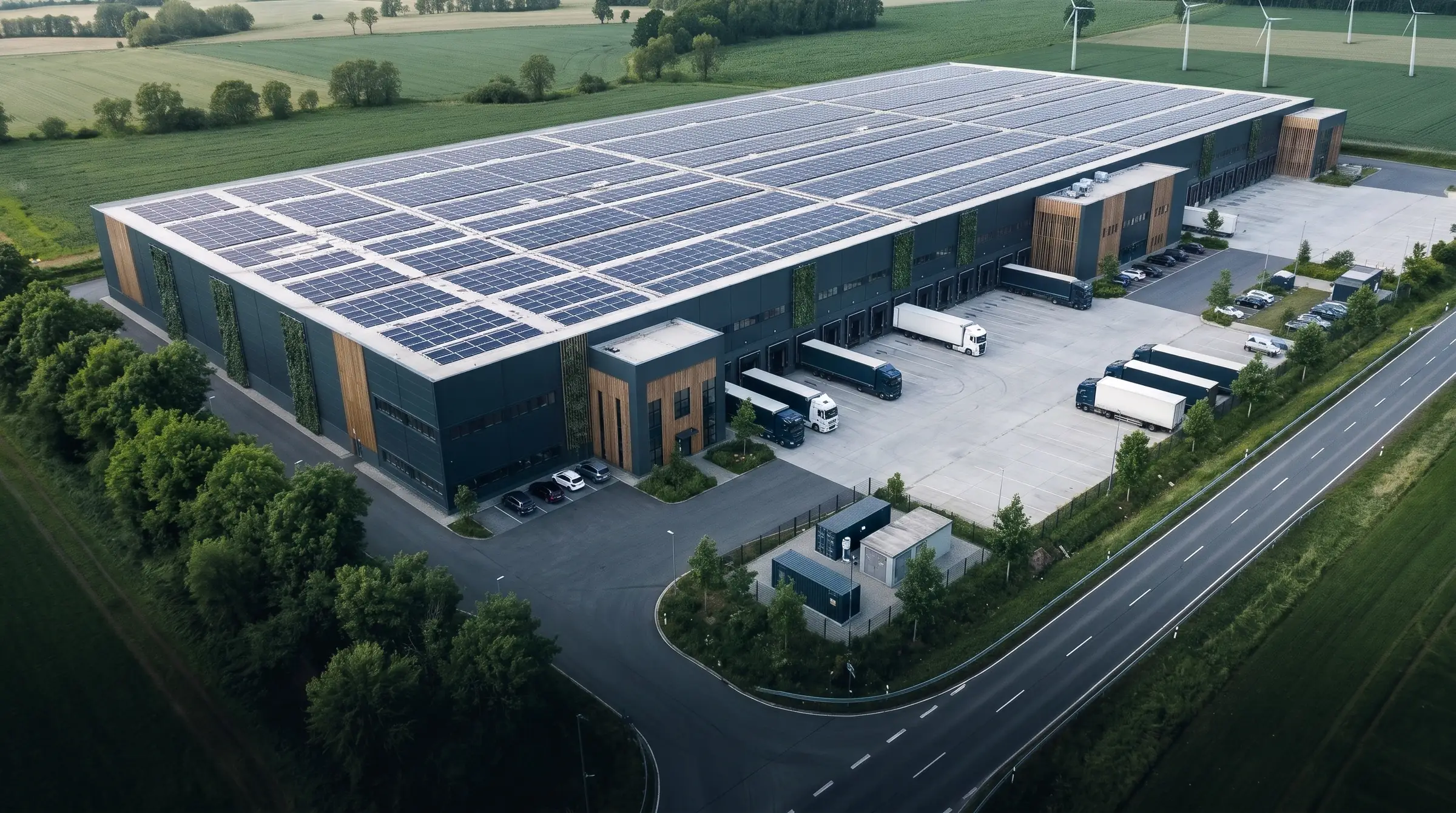
Large roofs, predictable loads, round-the-clock operation. Modern logistics properties can generate more energy than they consume and become genuine partners for municipalities and their regions.
Logistics as a power source
In many places, logistics developments are still seen as land-hungry, traffic-heavy and of little benefit to the community. That image dates from a time when warehouses were simple storage boxes. Today, new and refurbished assets offer large, structurally suitable roof areas, high-capacity grid connections and building services that can generate, store and distribute energy.
This shifts the role of the property. Beyond supplying the region with goods, it can provide power and heat to neighbours, fleets and districts. Only a small share of this potential has been realised so far. Where owners, occupiers, grid operators and municipalities collaborate early, it becomes a tangible local contribution to the energy transition.
Energy system on site
The logistics property as an energy hub for its surroundings
Power is generated on the roof, stored and used on site, and flows to where it is needed: fleets, neighbouring businesses, residential areas and the public grid.
- Warehouse with photovoltaicsThe roof generates solar power for operations, cooling and building services.
- Battery storageShifts surpluses into the evening and night and smooths peak loads.
- Charging e-trucks and fleetsChargers at docks and parking areas use the site's own power.
- Heat pump and waste heatHeat for offices and temperature-controlled areas without fossil fuels.
- Neighbouring businessesSupplying power to companies in the industrial estate.
- Residential areaIntegration into local supply models, for example via municipal utilities.
- Power gridFeeding in surpluses and secure supply via the grid connection.
What a logistics property can deliver in energy terms
Solar power on roofs and facades
Flat, contiguous and unshaded roof areas are particularly well suited to photovoltaics. South-facing facades and carports over car parking can add further capacity.
Storage and load management
Battery storage shifts solar power into the evening and night, smooths peak loads and reduces grid charges. An energy management system coordinates generation, consumption and charging.
Charging for e-trucks and fleets
Yards and parking areas become charging points for electric trucks, vans and cars. On-site solar power makes charging more predictable and less exposed to price volatility.
Heat without fossil fuels
Heat pumps, waste heat from refrigeration and plant, geothermal energy or combined heat and power cover the heating demand of offices, welfare areas and temperature-controlled storage.
Power for neighbours and districts
Surplus electricity can be fed into the grid, supplied to tenants or integrated into local supply models for neighbouring businesses, public facilities or residential districts.
Measure, control, evidence
Consumption data is captured and analysed. This creates transparency for ESG reporting, certification and financing and shows where further investment pays off.
 AI-generated
Logistics as a power source
The roof of a logistics building often generates more power than the operation beneath it needs.
What cities and municipalities gain
For municipalities, the question is no longer only whether a logistics development fits, but what it contributes to the location. Properly planned, a modern asset delivers far more than storage space.
Renewable energy on site
Large-scale photovoltaics on land that is already sealed protects open space and supports municipal climate targets.
Security of supply
Logistics ensures the daily supply of households, retail and industry. Local energy generation makes the location more resilient still.
Economic strength and jobs
Developments generate trade tax and employment, increasingly including skilled roles in engineering, IT and automation.
Land efficiency
Regenerated brownfield sites, multi-storey concepts and compact layouts reduce the need for new land.
Townscape and nature
Articulated facades, green roofs and walls, rainwater management and planted buffers integrate buildings into the landscape.
Traffic by design
Slot management, e-trucks, charging infrastructure and, where possible, rail access relieve town centres and residents.
Old image, new standard
| Common concern | What modern projects can deliver | Lever for the municipality |
|---|---|---|
| Lots of land, little benefit | Roofs generate power, brownfield sites are brought back into use, multi-storey solutions save land. | Priority for brownfields, roof-use requirements in the zoning plan |
| Grey box on the edge of town | Articulated facades, greening and timber or glazed elements in the office section. | Design codes, green space plan, design competition or design review panel |
| Round-the-clock truck traffic | Managed deliveries, electric fleets, noise protection and yards facing away from housing. | Traffic and noise assessments, urban development contract on routes and hours |
| Few jobs | Alongside warehousing and handling, roles emerge in engineering, controls, IT, maintenance and administration. | Early alignment with economic development, training partnerships |
| No role in climate and energy | Solar power, storage, heat pumps and charging infrastructure on site, certification to recognised standards. | Energy concept as part of planning, early involvement of the grid operator |
How municipalities can unlock the potential
Define objectives early
What contribution does the municipality expect on energy, design, traffic and employment? Clear expectations make planning easier for investors.
Use the zoning plan
Provisions on solar use, green roofs, rainwater, heights and design set binding standards for all applicants.
Plan for structure and grid
Roofs designed for photovoltaics and an early-agreed grid connection determine whether the potential can actually be used later.
Agree an urban development contract
Traffic routing, operating hours, compensation measures and the energy concept can be agreed on a project basis.
Engage residents
Transparent information and dialogue at an early stage reduce reservations and improve the project.
Bring partners together
Owners, occupiers, grid operators, municipal utilities and neighbours at one table, so energy is used where it is generated.
What owners and occupiers gain
ESG
Stronger sustainability metrics for reporting obligations, financing and investor relations.
Rooftop solar
Lower and more predictable energy costs through self-consumption of solar power.
Grid connection
More headroom where grid capacity is scarce, through on-site generation, storage and load management.
EV charging for trucks and fleets
A foundation for electrifying fleets and yard operations.
Re-lettability
Greater appeal to future tenants and buyers, because building services and energy supply are future-proof.
DGNB, BREEAM and LEED
Better conditions for certification under DGNB, BREEAM or LEED.
What needs to be resolved in practice
Roof structure
Older buildings are often not designed for additional loads. Lightweight module systems or reinforcement can help; new builds should be designed for photovoltaics from the outset.
Grid connection and feed-in
Available grid capacity limits feed-in and charging power. Early discussions with the grid operator are essential.
Fire safety and insurance
Rooftop installations require a concept agreed with the fire service, the property insurer and the fire safety engineer.
Contract and responsibility
Who invests, who operates, who benefits? The lease, roof use and power supply must be clearly regulated.
Regulation
Self-consumption, supply to third parties and grid feed-in are subject to different rules. Models should be reviewed from a legal and tax perspective before investing.
Read more
The invisible force: why logistics is more than a grey box on the horizon
Why logistics is often underestimated and how acceptance is built in municipalities.
Frequently asked questions
Can a logistics building generate more power than it consumes?
What role does the municipality play?
Is photovoltaics worthwhile on existing buildings?
Who benefits from the power generated?
How does LÈMANS support such projects?
A location with a future.
Planning a development, looking for an energy-efficient site or seeking to unlock the potential of your property? Talk to us.