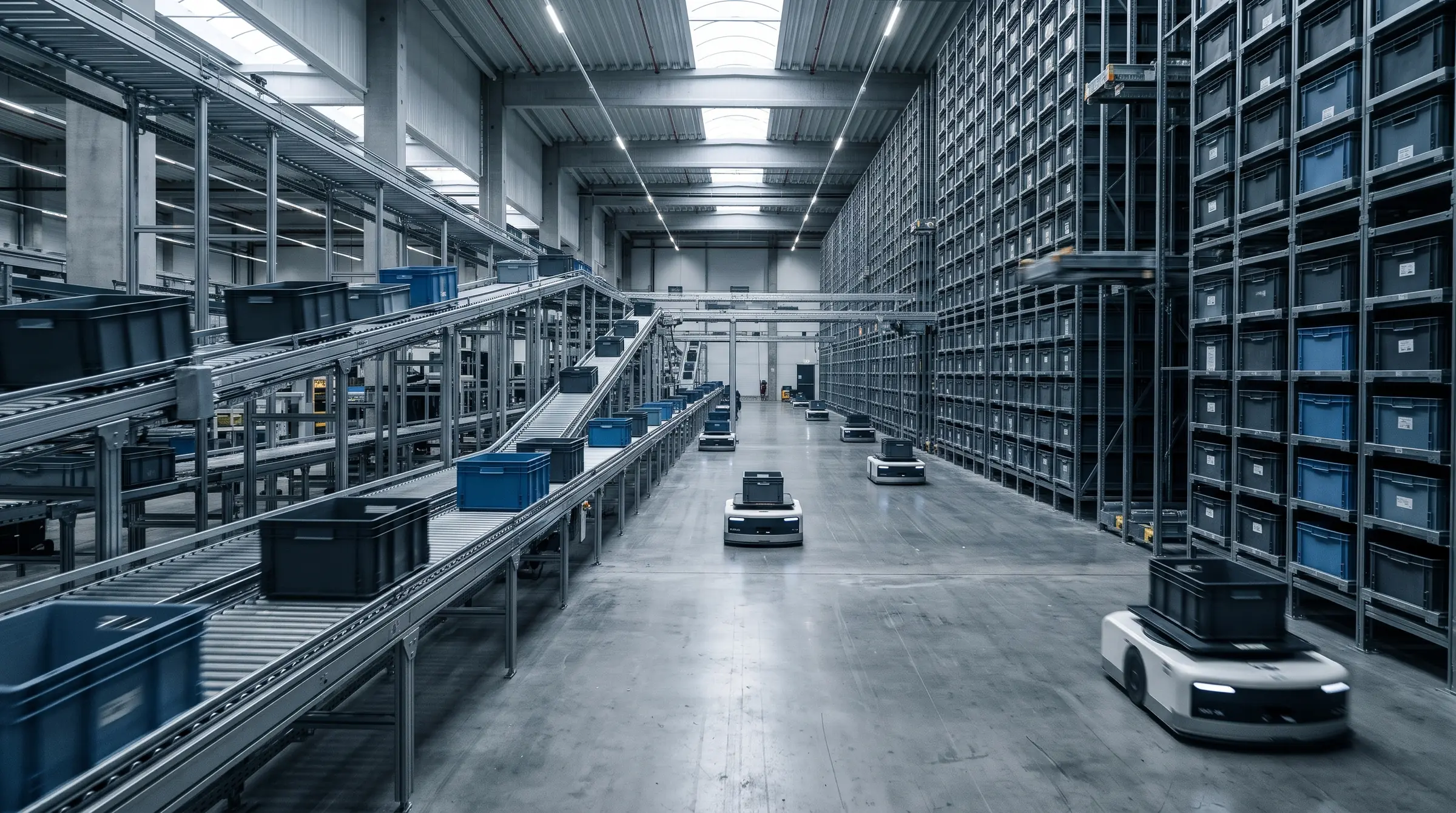
The logistics industry is currently undergoing profound change through digitalisation and automation. Driven by rising customer expectations, with delivery within 24 hours or even on the same day now considered almost standard, more and more companies are turning to digital logistics solutions to accelerate their processes. What appears to the end customer as a simple online order means highly complex operations for logistics providers, which would hardly be manageable without modern technology. Logistics 4.0 stands for this change: from intelligent planning systems to autonomous transport, the entire supply chain is being connected and optimised. Digitalisation and automation are therefore no longer optional improvements; they have become the logical consequence of, and the answer to, current challenges.
At the same time, these developments have a considerable impact on logistics properties themselves. Warehouses are changing from simple storage locations into high-tech hubs. Investors, developers and occupiers, that is companies that lease logistics space as well as those that acquire logistics properties or hold them as an investment, need to understand how their properties must adapt to these new requirements. Below, we examine the most important technological drivers of digital logistics and how they change the requirements for modern logistics space. We also look at how these trends affect rents and prices and what this means for the future of logistics as a commercial real estate asset class.
Technological drivers: AI, robotics, IoT, autonomous vehicles and warehouse automation
The digitalisation of logistics is being driven by a series of forward-looking technologies. Five key drivers are at the centre: artificial intelligence (AI), robotics, the Internet of Things (IoT), autonomous vehicles and warehouse automation. These technologies often interlock and together make possible the concept of smart warehousing, the intelligently connected warehouse.
- Artificial intelligence (AI): in logistics, AI systems are used above all for planning and optimisation. Using machine learning, they analyse large volumes of data along the supply chain. This allows forecasts of demand and sales that optimise inventory and avoid bottlenecks. AI also helps with truck route planning and the avoidance of empty runs, which reduces costs and improves sustainability. According to a recent study, 22% of logistics companies in Germany already use AI and a further 26% are planning to, from demand forecasting to transport optimisation. This high level of adoption shows that the industry has recognised AI's potential to increase efficiency and productivity.
- Robotics: in modern warehouses, robots are now a familiar sight. From fixed robotic arms that take over routine tasks such as palletising to autonomous mobile robots (AMRs) that navigate the aisles as automated forklifts or picking robots, warehouse automation is increasing rapidly. Leading global logistics companies are showing the way: at the e-commerce group Alibaba, robots already perform 70% of warehouse tasks, and the British online supermarket Ocado operates a fulfilment centre in which hundreds of robots store and retrieve goods on a giant grid. Amazon has also relied on robotics for years, from the orange Kiva robots to new types of sorting and delivery drones. These automated warehouses increase throughput and reduce human error. For smaller companies, entry costs are still high, but with wider adoption and scale, robotics solutions are becoming increasingly affordable and flexible.
- Internet of Things (IoT): the networking of devices and sensors, the Internet of Things, forms the backbone of digital logistics. Every package, every rack and every vehicle can now be fitted with sensors and tracked in real time. In an IoT-enabled warehouse, sensors record temperature and humidity, for example (important for food or pharmaceuticals), racks report when stock is running low, and pallets send their position to the warehouse management system (WMS). Digital logistics solutions are based on this wealth of data: from goods-in to goods-out, all objects and processes are transparent. This enables predictive maintenance of machines as well as dynamic real-time routing of industrial trucks in the warehouse. A prerequisite, however, is seamless connectivity within the building (Wi-Fi, 5G and fibre), which we will return to in the section on logistics property.
- Autonomous vehicles: autonomous transport systems have already arrived in intralogistics. Automated guided vehicles (AGVs) and self-navigating forklifts now routinely move goods within the warehouse. Development is also progressing outside the building: there are pilot projects for delivery robots on the last metres to the customer and for drones that deliver parcels. Fully autonomous trucks are still in the testing and approval phase, but intelligent truck fleets with semi-autonomous functions, such as platooning (electronically coupled convoy driving), are set to change freight transport. Autonomous vehicles promise not only cost savings but could also help alleviate the shortage of drivers. To support this trend, logistics properties will in future need to provide charging infrastructure for electric trucks and specially designed manoeuvring areas for autonomous trucks and delivery robots.
- Warehouse automation: warehouse automation covers technologies such as automated conveyors, sorting systems and high-bay warehouses with automated storage and retrieval machines (AS/RS, automated storage and retrieval systems). Fully automated high-bay warehouses can accommodate considerably more goods on the same footprint, because they build upwards and store goods in a computer-optimised way. This achieves higher throughput per square metre, and processes often run 24/7, sometimes in unmanned shifts. However, completely dark, unmanned warehouses (lights-out warehouses) are still the exception, since many processes continue to require human flexibility and robots are still inferior to people in dexterity. The direction is clearly towards higher levels of automation, though: combining people and machines, for example staff with supporting wearables (smart glasses, smartwatches) or exoskeletons for physical relief, makes warehouse processes faster and more efficient. Staff and automation technology can thus work hand in hand to meet growing demands.
Together, these technologies bring about a quantum leap in logistics performance. Processes are accelerated, errors minimised and costs reduced. Automation also helps to address the shortage of skilled workers in logistics, a problem that many European countries are already feeling acutely. When fewer staff are needed for monotonous or physically demanding work, employees can concentrate on higher-value tasks. The digital transformation of logistics has thus become a decisive competitive factor. But what do these technical changes mean for the buildings in which logistics takes place?
Changing requirements for logistics property: smart warehousing, flexible use concepts, sustainable buildings
The technologies described only reach their full potential in the right environment, that is in logistics properties designed for them technically and conceptually. The warehouse of the future must therefore do much more than provide four walls and a roof. Three aspects are paramount: it must be smart (digitally connected), flexible in use and meet the requirements of sustainability. These changing requirements directly affect the planning, construction and operation of modern logistics properties.
Smart warehousing and digital infrastructure: a modern logistics property is a high-tech building. Powerful digital infrastructure is indispensable for IoT devices, autonomous systems and cloud-based applications to function smoothly. Specifically, this means comprehensive high-speed internet, redundant fibre connections and stable mobile coverage inside the warehouse. Many logistics centres already install redundant systems, with several independent internet connections, to avoid outages. Automation also increases energy demand within the building, for example to operate robots, conveyor systems or server rooms. Power supply and cooling of the technical installations must therefore be planned from the outset. Backup systems (emergency generators, UPS systems) are also becoming more important so that a power cut does not bring the entire automated warehouse to a standstill. Smart warehousing also means that building services, warehouse technology and IT systems are closely interlinked: ideally, the building management system communicates with the warehouse management system to optimise lighting and heating, for example. In areas with fully automated operation, temperatures can be lowered or lights dimmed, which saves operating costs. This intelligent networking requires close cooperation between developers and logistics and IT experts as early as the construction phase. The logistics property effectively becomes a smart building that meets the specific needs of digital warehouse processes.
Flexible use concepts and space design: the rapid pace of change in logistics calls for flexible properties that can adapt to new requirements. Where a largely standardised warehouse used to suffice, tailor-made solutions are now often in demand. Developers report that they now plan logistics buildings "more and more often around the machines". Modern warehouse concepts incorporate, for example, special floor specifications (extra load-bearing and flat floors for AGVs and high-bay systems), greater clear heights for many racking levels or pre-installed sensors and cabling for automation technology. There is also growing demand for multi-storey logistics properties in urban areas. In metropolitan regions where land is scarce and expensive, logistics buildings are increasingly planned vertically, as two- or even three-storey warehouses with ramps or goods lifts between the levels. Such multi-level logistics centres, already widespread in Asia, are now also emerging in Europe and Germany (first projects in Hamburg and Cologne, for example) as a response to land shortages and the desire for storage close to cities. They provide twice the usable area on the same footprint and can also combine different uses, such as storage on the ground floor and light industry or even offices on upper floors. These flexible use concepts increase the alternative-use potential of a logistics property, an advantage for investors because alternative uses or tenants can be considered if needed.
Flexible concepts also mean upgrading existing properties. Older warehouses that are no longer technically up to date can often only be let at a discount to prime rents. Instead of demolishing every outdated property, however, revitalisation is coming into focus. Developers extend life cycles by retrofitting warehouses with modern technology (for example ground-level doors for automated forklifts, stronger roof structures for photovoltaics or new sprinkler systems for changed storage heights). This is complex, but given the resource and CO₂ costs of a new build, it often makes sense. In future, logistics properties will have to be designed from the outset so that they can be extended modularly and retrofitted technically. A warehouse can then accompany several innovation cycles in warehouse technology over the decades without becoming obsolete.
Sustainable buildings: alongside smartness and flexibility, sustainability has become the third key issue for logistics property. Many large occupiers and investors today pursue ambitious ESG targets, which translates directly into requirements for warehouse buildings. Modern logistics properties are expected to be built and operated in an energy-efficient, environmentally friendly way that also considers the well-being of employees. In practice, this shows in several areas: new buildings can be certified to established standards such as DGNB, LEED or BREEAM, which ensures a holistic catalogue of criteria from energy to materials to social aspects. Photovoltaic systems on large warehouse roofs have become almost standard, covering part of the high electricity demand of automated systems and reducing the carbon footprint. Some developers also green their roofs or even install beehives to contribute to biodiversity. EV charging points for electric trucks, vans and employees' cars are also increasingly part of the basic specification, both to serve the future electric fleet and as a signal of climate responsibility. Materials and construction methods also play a role: timber-hybrid structures or recycled concrete are increasingly used to reduce CO₂ emissions in construction and operation. But sustainability does not only mean ecology: the social environment is also considered. Advanced logistics centres integrate rest areas and canteens for staff, improved lighting and ventilation concepts and training rooms to create a pleasant and productive working environment. In cities, attention is also paid to noise protection and traffic management so that residents are less affected. These measures are no longer just nice to have; they are becoming factors that determine whether a logistics property is fit for the future. A building that enables environmentally and socially sustainable logistics will be considerably more attractive in the market, especially against the background of stricter regulation and growing awareness among tenants and consumers.
In summary, logistics properties are changing from pure storage space into intelligent, adaptable and green infrastructure assets. Developers are called upon to take a holistic approach in new projects that considers technology and sustainability from the planning phase. For owners of existing stock, it is becoming important to make their properties future-proof through retrofitting and innovative concepts in order to remain competitive for tenants.
Impact on rents and prices: automated warehouses as an investment factor
The trends described also have a direct effect on the market values of logistics property. The market for warehouses and distribution buildings was already booming in recent years: driven by e-commerce and the strategic importance of supply chains, demand for logistics space rose rapidly while supply remained tight in many regions. The result was historically low vacancy rates and significant rental growth in key logistics hubs. This boom brought logistics property as an asset class into the focus of many investors; logistics investments are now regarded as high-yielding and relatively resilient. With advancing digitalisation, however, the requirements for space are changing, with differentiated effects on rents and prices.
Strong demand for modern space: occupiers prefer modern logistics space that meets the characteristics mentioned above (technology, sustainability, location). For such state-of-the-art assets, tenants are willing to accept higher rents, because the efficiency gains from automation often save costs elsewhere. Industry experts observe that more and more customers are prepared to pay a premium for the "right space", meaning a technology-equipped property optimally tailored to their needs. Leading online retailers now spend around four times as much of their revenue on warehousing and logistics costs as they did 10 to 20 years ago. Logistics property has evolved from a cost factor into a strategic success factor, which increases willingness to pay. Accordingly, first-class automated warehouses in prime locations are seeing continuous rental growth. In Germany, prime rents in logistics regions have recently risen by several percent per year; despite a slight market cooling in 2023, rents remain at a high level and could continue to grow in the long term. For investors acquiring logistics property, this means attractive prospects of rental growth and capital appreciation, especially for assets with a future-proof specification.
Discounts for outdated assets: on the other hand, properties that do not meet technological requirements face noticeable discounts. Older warehouses without sufficient clear height, without modern IT infrastructure or without energy efficiency measures are avoided by tenants or only let at significantly lower rents. Such assets must either be retrofitted (which requires initial investment) or fall by the wayside. However, the generally strong demand for space means that even secondary locations and older stock still find occupiers in some regions, albeit on correspondingly adjusted terms. In sales, market analysts observe growing price differentiation: logistics investments with long-term leases to financially strong, technology-driven tenants achieve top prices and low yields (at the end of 2022, prime yields for core logistics assets in Germany were in some cases below 4%), while assets with uncertainties (short remaining lease terms, high capex needs for modernisation) are valued with risk discounts. The development of demand is clearly heading towards automated, sustainable new-build space, which is reflected in investors' capital allocation.
Longer leases through automation: an interesting effect of automation on lease structures is the trend towards longer terms. Since many tenants invest considerable sums in the technical fit-out of their leased warehouses, they have a strong interest in using these investments over a longer period. Occupiers who equip a warehouse with their own robots and conveyor systems, for example, tend to sign leases of 10 or 15 years instead of 5 years as in the past, in order to amortise their outlay. For landlords and investors, this means greater planning certainty and stable cash flows, a positive aspect for property value. At the same time, the requirements for building quality in leases are rising: aspects such as power supply capacity, climate control or floor load capacity are increasingly fixed contractually to ensure suitability for the planned digital logistics solutions.
Construction and operating costs: it should not be overlooked that technically more demanding logistics properties also initially incur higher construction costs. Additional equipment, stronger foundations and more complex planning all drive up construction costs. In recent years, material prices and land costs have also risen considerably, making new builds more expensive. These costs are partly passed on through higher rents, which raises the general rent level. On the operating cost side, automation can also have an effect: more technology means higher power consumption and maintenance, which increases service charges. This is offset by savings, for example in staff costs or through more efficient use of space. Ultimately, however, occupiers calculate carefully whether a highly automated site pays off for them. Demand is therefore concentrated on locations where the use of technology pays off through high throughput volumes (large distribution centres, central hubs) or where it is particularly necessary (for example in regions with labour shortages).
Overall, logistics property as an asset class remains in high demand. Despite short-term economic uncertainty and interest rate rises, many market players continue to trust in the positive fundamentals. In many places, rents are moving sideways at a high level or continue to rise moderately, while no oversupply of high-quality assets is in sight. On the contrary, in some places there is still a shortage of space that puts pressure on prices. For investors with a long-term horizon, logistics property therefore remains among the most attractive commercial real estate. What matters, however, is to focus on quality and future viability: leasing or investing in logistics property pays off above all when the buildings can keep pace with logistics innovation.
Outlook: how logistics property must evolve
Looking ahead, it is clear that digitalisation and automation in logistics will accelerate further. Technological breakthroughs, whether a new generation of AI-controlled robots, the widespread use of autonomous trucks or entirely new concepts such as drone-based delivery, will continuously raise the requirements for logistics space. Logistics properties of the future must therefore become even more adaptable and intelligent than they already are.
One likely scenario is the increasing integration of logistics property into urban areas. City logistics and last-mile distribution centres will gain in importance to shorten delivery times further. This could mean more urban logistics hubs in city centres, for example in the form of mixed-use properties that combine storage with retail, offices or housing. Such concepts require creative property solutions to reconcile logistics, with its requirements for deliveries, noise protection and so on, with other uses. For developers and cities, this offers opportunities to rethink traditional warehouses and integrate them into the urban fabric.
Technologically, logistics buildings are likely to operate even more autonomously in future. Warehouses are conceivable that, thanks to advances in robotics, actually manage without lighting and heating for people, because machines do most of the work. AI could act in the form of self-learning warehouse management systems that optimise stock, use of space and maintenance entirely independently. Companies are already experimenting with digital twins of their warehouses to run through scenarios and manage the real property optimally. In future, every new building could first be planned and optimised as a virtual twin before being built physically. This would minimise planning errors and make buildings an even better fit.
From a development perspective, the future means that standard solutions will become rarer. As one developer put it: "There used to be a relatively fixed standard to build to. Today there are fewer and fewer standardised buildings." This will continue. Every large warehouse project will have individual components, whether special provisions for automation, particular sustainability features or architecture that fits into urban surroundings. Planning teams are becoming more interdisciplinary: logistics experts, IT planners, architects and sustainability specialists work hand in hand to create properties ready for Logistics 4.0.
For existing properties, meanwhile, the motto is "keep up or make way". Owners of older warehouses must invest to remain competitive with new builds. Upgrading existing assets, for example by installing smart technologies or improving energy efficiency, will become a core task in the coming years. Since entirely new developments are not possible without limit because of high construction costs and climate targets, such upgrades are gaining importance. One example: retrofitting a 20-year-old logistics centre with modern sensors and an autonomous conveyor system can greatly increase its attractiveness to tenants and open up new use options. Unused warehouse height could also be unlocked with mezzanines or automated storage lifts to create more capacity. The logistics property of tomorrow is therefore not necessarily a new build on a greenfield site, but often a cleverly optimised existing building brought into the digital age.
Finally, sustainability will remain the great common denominator in the long term. Regulatory requirements for CO₂ reduction, rising energy prices and a growing sense of social responsibility mean that no major logistics project can do without a sustainability concept. Innovations such as energy storage in buildings, water recycling or even lower-emission building materials will play a role here in future. Logistics properties could develop into energy hubs that, for example, feed surplus solar power into the grid or provide charging infrastructure not only for their own purposes but also for the neighbourhood.
For investors, asset managers and companies, all this means that flexibility and foresight are called for. Anyone investing in logistics property today should anticipate tomorrow's trends. The property must be technology-ready, for example by offering space reserves for additional equipment or by allowing digital upgrades. It must be in the right location, close to labour or end customers, depending on whether automation replaces people or proximity. And it must be sustainable in order to be operated economically in the long term and to find acceptance. If this succeeds, logistics property will remain a highly attractive investment. The combination of robust demand growth (through e-commerce, spare-parts logistics, production warehouses due to reshoring and more) and the possibility of achieving considerable increases in value creation in a property through automation makes this sector unique.
Conclusion: digitalisation and automation are changing logistics at a rapid pace, and with it the buildings in which logistics takes place. Logistics properties will have to be intelligent, flexible and green in future to meet the requirements of investors, developers and occupiers. Those who offer or use such modern logistics space gain a decisive competitive advantage. The course has been set: the logistics property of the future is digitally connected, highly automated and plays a key role in global flows of goods, an exciting field for all market participants in the sale, letting and investment of logistics property.