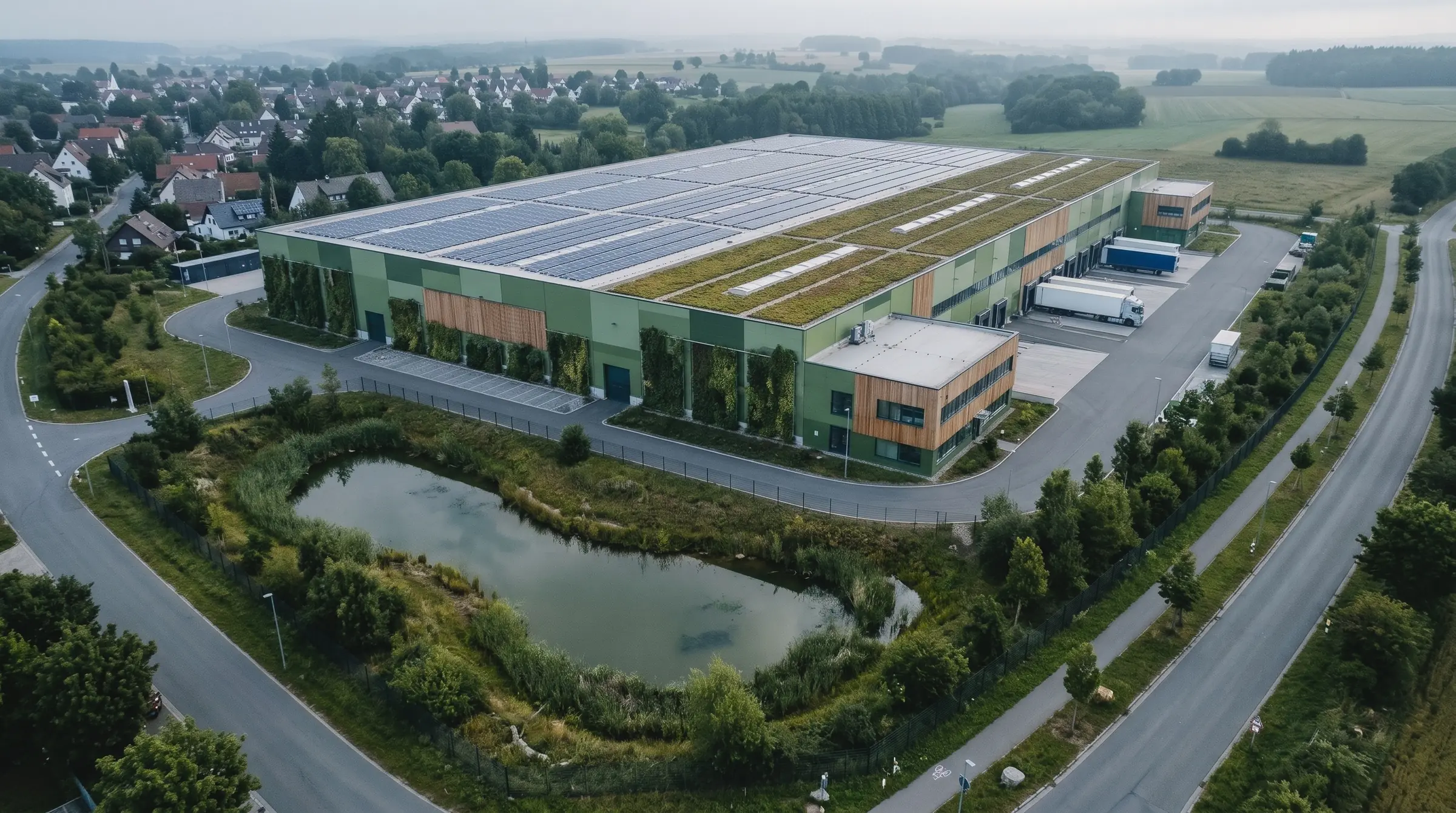
Logistics property has an image problem. In the minds of many mayors, councillors and residents, a clear picture has taken hold: huge grey warehouses that seal valuable farmland, attract endless convoys of trucks and create only a few jobs. At a time when calls for affordable housing, climate protection and high-value industry are growing louder, logistics often appears as an unwelcome consumer of land. Developers increasingly meet resistance, and planning procedures drag on or are blocked altogether.
Yet this critical stance, however understandable it may seem at first glance, falls short. It overlooks the fundamental structural change the German economy is undergoing and ignores the enormous, largely untapped potential of modern logistics property. As online retail grows, global supply chains are reorganised and industry depends on just-in-time production, logistics is becoming the backbone of essential public services. It is the invisible force that fills supermarket shelves, keeps factories running and ensures that the parcel ordered today arrives tomorrow.
This article takes a sober look at the lines of conflict. It analyses the legitimate objections of cities and municipalities and then shows how logistics property can evolve from a passive land user into an active provider of solutions, particularly in the key areas of sustainability and energy supply. The future of logistics does not lie in ignoring criticism, but in using it as a spur for innovation and forging new, sustainable partnerships with municipalities.
The criticism: why municipal scepticism is justified
Opposition to logistics projects is rarely unfounded. It stems from tangible concerns based on decades of experience with conventional buildings. To find solutions, the problems must first be acknowledged.
1. Land take and the "30 hectare target"
Germany has a land problem. According to the Federal Environment Agency, around 55 hectares are newly designated for settlement and transport every day (as of 2022), equivalent to almost 78 football pitches. In its sustainability strategy, the federal government has set the target of reducing this figure to less than 30 hectares per day by 2030. Logistics properties, which often require plots of 50,000 to 100,000 square metres or more, are a red rag in this debate.
The accusation carries weight: while land is urgently needed for housing, social infrastructure and future-oriented industrial jobs, logistics occupies vast areas, often on greenfield sites. This land take contributes to urban sprawl, fragments habitats for flora and fauna and destroys valuable agricultural soil. Sealing the ground also prevents rainwater from infiltrating, which increases the risk of local flooding and impairs groundwater recharge, a critical issue at a time of increasingly extreme weather.
2. Low employment density relative to land area
A common argument from municipalities is: "For this huge area, we get too few jobs, and often only low-skilled ones." A conventional 20,000 square metre logistics warehouse often creates only between 50 and 100 jobs. By comparison, a medium-sized manufacturing business can employ a considerably larger number of skilled workers on a much smaller area and generate higher trade tax revenue.
Although automation, for example through robotics and automated guided vehicles, has greatly increased efficiency in logistics, it has also meant that employment density per square metre in state-of-the-art centres can fall further. For a municipal treasurer, the calculation is simple: trade tax revenue is not in an attractive proportion to the building land sacrificed, which could alternatively have been used by a technology company or a manufacturing business.
3. More traffic and emissions
Every logistics centre is a node for flows of goods and therefore inevitably generates traffic. Concern about hundreds of additional truck movements per day is one of the main reasons for local protests. Residents fear round-the-clock noise, greater strain on local road infrastructure and an increase in pollutant emissions such as nitrogen oxides (NOx), particulate matter and carbon dioxide (CO2).
The "last mile" is viewed particularly critically: the growing number of delivery vehicles in urban areas leads to congested roads, parking problems and further strain on air quality. As long as transport logistics relies mainly on diesel vehicles, the conflict between security of supply and climate protection remains unresolved.
4. The image problem: architecture, acceptance and loss of value
Aesthetics are a factor not to be underestimated. Logistics properties are often perceived as monotonous, windowless "grey boxes" or "shoe boxes" that spoil the landscape and offer no architectural added value. This lack of design quality leads to low public acceptance.
There is also concern about the "downgrading" of the municipality. Some decision-makers fear that a dominance of logistics developments undermines their location's image as an innovative, high-quality business region. This perception sometimes leads to paradoxical situations: even when industrial wasteland is to be revitalised (so-called brownfields), which is the most sensible option ecologically and in planning terms, logistics projects are rejected. Municipalities prefer to wait for a supposedly "higher-value" industrial occupier, a wait that can last for years while the site remains unused and deteriorates.
The opportunities: how modern logistics properties become partners for solutions
The points of criticism listed are valid, but they are often based on the logistics of yesterday. The industry has moved on and can now provide answers to many of these challenges. Modern logistics properties are no longer merely passive land users; they can make an active contribution to local value creation, the energy transition and environmental protection.
1. From land consumer to energy supplier: the potential of roof space
The greatest and often unused resource of a logistics warehouse is its roof. With areas of 10,000, 20,000 or even more than 100,000 square metres, these roofs are ideally suited to large-scale photovoltaic (PV) systems.
A study by the Fraunhofer Institute for Solar Energy Systems (ISE) has confirmed the enormous potential. Logistics roofs in Germany could theoretically provide dozens of gigawatts of solar capacity. A modern logistics centre can thus not only cover its own energy needs, for example for lighting, conveyor technology, cooling and charging infrastructure for electric vehicles, but become a regional power station.
The benefits for the municipality are manifold:
- Contribution to the energy transition: decentralised generation of green electricity supports local and national climate targets.
- Grid stability: the electricity generated can be used directly on site or fed into the local grid, relieving the networks.
- New business models: municipalities could purchase surplus electricity through their municipal utilities and market it to residents or neighbouring businesses. Models in which citizens invest directly in the PV system (community solar plants) are also conceivable.
- Sector coupling: solar power can be used to produce green hydrogen or stored in batteries to increase security of supply.
In this way, the logistics property is transformed from a pure cost factor (infrastructure, land take) into an asset in the municipal energy balance.
2. The circular approach: brownfield revitalisation instead of greenwashing
The most sustainable property is the one that is never built on a greenfield site in the first place. In recent years, the logistics industry has taken a leading role in the revitalisation of brownfields. These are former industrial or military sites that lie fallow and are often contaminated.
Preparing these sites is complex and expensive. It requires soil remediation, demolition of old facilities and careful planning. But the benefits are immense:
- No new soil sealing: valuable farmland and natural areas remain untouched.
- Reactivating eyesores: derelict sites within the urban area are brought back into use and integrated into the townscape.
- Use of existing infrastructure: brownfields are often already well connected to road and rail networks, which reduces the need for new transport routes.
By specifically promoting such projects and accelerating approval procedures for brownfield developments, municipalities can actively manage land take while winning logistics as a partner for sustainable urban development.
3. More than just concrete: sustainability in construction and operation
Modern logistics properties increasingly rely on environmental standards that go far beyond legal requirements. Certification systems such as DGNB (German Sustainable Building Council) or BREEAM are becoming the industry standard. Concrete measures include:
- Low-carbon construction: timber as a building material (for example for roof structures), recycled concrete and a resource-efficient choice of materials.
- Biodiversity and water management: green facades and roofs do more than improve appearance; they improve the microclimate, bind particulate matter and create habitats for insects. Intelligent rainwater management systems with cisterns and infiltration swales collect precipitation, use it as grey water (for example for toilet flushing and irrigation of green areas) and relieve the municipal sewer system.
- Energy efficiency: highly insulated building envelopes, LED lighting with intelligent controls and energy-efficient heating and cooling systems such as heat pumps minimise energy consumption in operation.
These measures make the logistics warehouse an ecologically well-designed building that integrates better into its surroundings.
4. Intelligent transport concepts to relieve infrastructure
The traffic burden cannot be denied, but it can be managed intelligently. Modern logistics locations rely on multimodal concepts:
- Rail connection: freight villages (GVZ) with their own rail sidings can massively reduce long-distance truck traffic. Transport by freight train is considerably more environmentally friendly than by truck.
- E-mobility and charging infrastructure: the electrification of truck and delivery fleets is well under way. Logistics centres are becoming important charging hubs. Solar power generated on the building's own roof can be used directly to charge vehicles. This significantly reduces not only CO2 emissions but also noise.
- City hubs and micro-depots: to optimise last-mile traffic, smaller city hubs are emerging on the edges of city centres. From there, goods are distributed with zero-emission vehicles such as cargo bikes or small electric vans. This reduces congestion and improves air quality in cities.
A question of perspective: stakeholder interests
A win-win situation can only arise if the needs of all parties are taken into account.
- For investors: sustainability has long ceased to be a soft factor and is now a hard economic one. Properties that meet high ESG (environmental, social, governance) criteria hold their value better, are easier to let and attract long-term investors. Revenue from electricity generated by PV systems creates additional, predictable returns and makes the property less dependent on fluctuating energy prices.
- For tenants and occupiers: for retail and industrial companies, functioning logistics is existential. Strategically located, sustainable sites secure their own supply chain. Using green electricity generated on site helps them meet their own decarbonisation targets and reduce energy costs. Modern, well-equipped properties are also an important factor in competing for staff.
- For municipalities: the most important insight for cities and municipalities should be: logistics is an indispensable part of essential public services. It not only supplies the population with everyday goods but is also the lifeline of local industry and retail. A municipality that blocks logistics developments across the board jeopardises the long-term competitiveness of its entire business location. The opportunity lies in actively seeing logistics as a partner in achieving municipal goals such as energy, climate and land recycling.
Strategies for greater acceptance: from confrontation to cooperation
How can the change succeed in practice? It requires a new dialogue and a new form of cooperation.
- Early and transparent dialogue: developers must approach municipalities, citizens' initiatives and residents from the outset. Instead of presenting finished plans, needs should be analysed and solutions developed in joint workshops. Transparent communication about traffic volumes, noise protection measures and environmental concepts builds trust.
- Sustainability as a negotiating lever: municipalities should not only demand sustainability but anchor it as a central point in development plans and urban development contracts. Binding requirements for PV systems, green roofs, water management and architectural quality can separate the wheat from the chaff.
- Integrating added-value functions: why not combine logistics with other uses? A warehouse could integrate office space for start-ups, craft businesses or co-working spaces. Part of the PV energy could be supplied at a reduced price to a neighbouring residential area. The charging infrastructure could also be made publicly accessible. Such synergies create direct added value for the community and increase acceptance.
- Political course-setting: policymakers are called upon to create the right framework. This includes simplifying approval procedures for brownfield projects, promoting multimodal transport concepts and creating incentives for particularly sustainable construction projects. A clear commitment is needed that logistics is not the problem but part of the solution for a sustainable economy.
Conclusion: rethinking logistics as a supplier of energy and goods
Rejecting logistics property across the board is a luxury we cannot afford in a globally networked economy based on the division of labour. The legitimate criticism of land take, traffic volumes and aesthetics must be taken seriously. But it must not obscure the fact that the industry is in the midst of a fundamental transformation.
The modern logistics property is much more than a warehouse. It has the potential to be a decentralised power station that supplies clean energy for the whole community. It can act as an engine for recycling industrial wasteland and thereby protect valuable natural areas. Through intelligent transport and building concepts, it can minimise its environmental footprint and make a positive contribution to biodiversity.
The path to greater acceptance leads through partnership and dialogue. Municipalities that see logistics not as a necessary evil but as a strategic partner can set the course for sustainable development. And developers who regard sustainability not as a marketing gimmick but as the core of their business model will be the winners of tomorrow.
It is time to overcome the outdated image of the "grey box" and to see logistics for what it can be at its best: an innovative and indispensable supplier of sustainable energy and future-proof flows of goods.