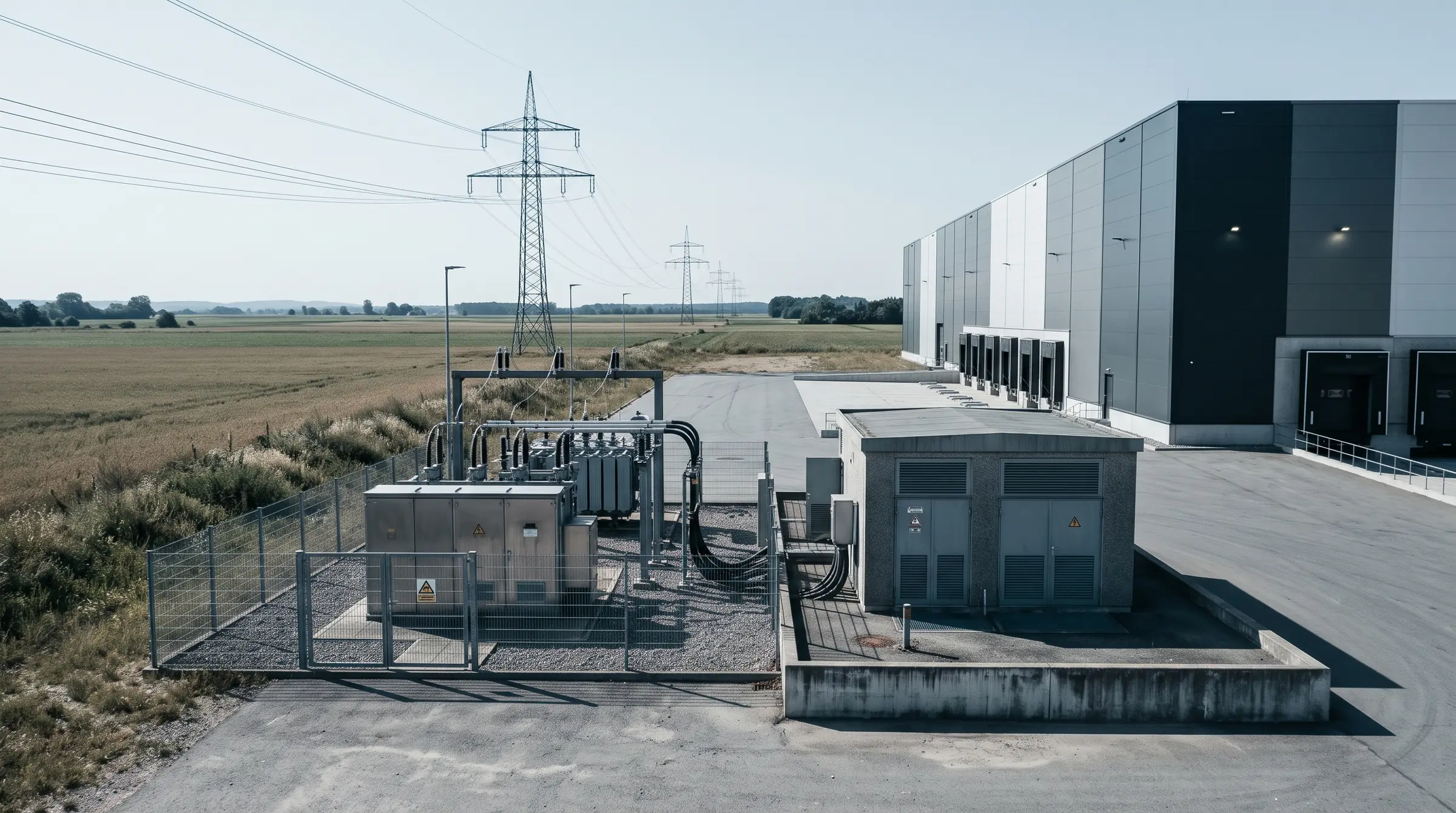
A bottleneck with cross-sector consequences
Anyone planning a logistics property with a high connection capacity today, whether an automated high-bay warehouse, a cold store or a depot with charging infrastructure for electric trucks, increasingly encounters an obstacle that has little to do with traditional site planning: the availability of a secured grid connection. According to the energy industry, more than 700 gigawatts of connection requests are awaiting processing nationwide, a multiple of the generation and consumption capacity actually installed. Kirsten Westphal, Chief Executive of the German Association of Energy and Water Industries (BDEW), recently summed up the scale of the problem: an industrial country simply cannot afford lead times of eight to twelve years for new grid infrastructure. The remark was made in the context of the current debate on the so-called grid package, with which the federal government aims to accelerate procedures, while on 24 September 2026 the Bundestag was also debating a bill that addresses grid congestion differently: through more restrictive control of new capacity in grid sections that are already overloaded.
For decision-makers in industrial and logistics property, this combination of delays, regulation and political negotiation is more than a footnote of energy policy. The grid connection has become a project risk in its own right, one that influences timelines, location decisions and ultimately the economics of new builds and repositionings.
When the power connection becomes a project risk
How heavily a lack of grid capacity can weigh on location projects is currently evident at numerous sites across the country, even if individual cases are rarely discussed publicly with this degree of clarity. According to the consultancy AFRY, around 40,000 energy and storage projects in Germany are waiting for a secured grid connection, many of them considerably longer than originally planned. A recurring pattern is that even immediate proximity to a large power plant or generation site is no guarantee of a quick connection once feed-in and connection demand sit on different grid levels and the regional distribution grid has little spare capacity. In such constellations, municipalities sometimes create planning permission for new commercial and industrial land before the question of the grid connection has been finally resolved, which burdens project development and location decisions with a considerable time risk, sometimes lasting several years.
Several lessons for logistics and industrial property can be drawn from such situations. First, they show that planning permission and political will to attract investment do not on their own guarantee a secure power supply. Second, they make clear that proximity to generation assets is no shortcut if the grid levels are not compatible. Third, they illustrate that investment decisions taken on the basis of optimistic connection commitments carry a considerable residual risk, which should be reflected in construction schedules, financing commitments and lease terms.
The legislator's response: prioritisation instead of first come, first served
The federal government is responding to the capacity bottlenecks with the so-called grid connection package, the government draft of which was presented in summer 2026. Its centrepiece is the abolition of the previous first-come, first-served principle, under which connection requests were simply processed in the order received. It is replaced by a prioritisation system that allows grid operators to rank connection requests according to qualitative criteria, such as their importance for system stability, renewable expansion targets, the scenario framework of the Federal Network Agency or consistency with municipal spatial and land-use planning. For companies whose projects are located at so-called grid-supportive sites, or that rely on instruments such as cable pooling and flexible load profiles, this potentially opens up advantages in the connection process. Sites in grid sections that are already congested, by contrast, risk additional burdens from new construction cost contributions or capacity limits, which some industry representatives criticise as a brake on investment.
In parallel, grid operators will in future have to provide binding status information within three months of receiving a connection request, and available grid capacity is to be published online every month. From 2028, digital grid connection portals will also become mandatory for applications with a rated capacity of 135 kilowatts or more, which is relevant for most commercial and industrial connection requests. A separate rule on the so-called redispatch reservation, under discussion in the Bundestag, would also allow distribution grid operators to designate individual grid sections as congestion areas for up to six years if at least five percent of annual electricity generation there could not be transported away. In such areas, compensation for curtailed generation assets falls significantly, which in the government's view should create incentives for better coordination between generation and grid expansion. Critics from the opposition parties, however, see this as a brake on renewable expansion and call instead for more flexibility through battery storage and decentralised energy parks.
Growing power demand in logistics as a stress test
The increasing urgency of these reforms is also due to the foreseeable development of electricity demand within the logistics industry itself. A study published in June 2026 by the Institute for Automotive Engineering at RWTH Aachen University on behalf of the German Freight Forwarding and Logistics Association (DSLV) puts the future electricity demand of German logistics at up to 186 terawatt hours per year in 2045, equivalent to around 14 percent of Germany's current total electricity demand. As early as 2035, demand of around 110 terawatt hours is forecast, a level that exceeds the consumption of some of today's industrial sectors. By far the largest driver is the electrification of road freight, which according to the study accounts for around 84 percent of future total demand, while logistics properties themselves, that is distribution centres, cold stores and high-bay warehouses, account for around 22 terawatt hours in 2045.
These figures show that the industry's electricity demand will grow not linearly but in leaps, as soon as fleet operators switch to battery-electric trucks on a larger scale and install charging infrastructure with high simultaneity at their hubs and distribution centres. For individual sites, this means connection capacities that can be on the order of smaller industrial plants, a scale that many existing grid connections at traditional logistics locations do not provide today. Anyone wishing to upgrade an existing asset for later electrification or to connect a new development in a future-proof way must therefore factor grid capacity into site and expansion planning much earlier and much more ambitiously than has been customary in recent years.
Costs and distribution: network charges and investment needs
The foreseeable investment required to cope with this development is substantial. The 82 largest German distribution grid operators alone put their investment needs at around 110 billion euros by 2033, while the four transmission system operators expect costs of around 50 billion euros by 2030. To cushion the resulting burden on electricity customers, the federal government decided at the beginning of 2026 on a federal subsidy of 6.5 billion euros towards transmission network charges, which has been reflected in pricing since January 2026. BDEW regards this subsidy as an important contribution to preserving industrial competitiveness, but also points out that commercial and industrial customers, because their connections sit closer to the transmission grid, tend to benefit more from the relief than private households, although the actual effect varies considerably by region. In addition, following a decision by the Bundestag budget committee in January 2026, the federal government has taken a 25.1 percent stake in the transmission system operator Tennet for 7.6 billion euros, a signal that the state is increasingly securing grid expansion with direct capital as well.
For investors in logistics and industrial property, these fiscal decisions are relevant because they change the cost base for existing and new assets over the medium term. Lower network charges improve operating cost calculations for energy-intensive uses, while new construction cost contributions for connections in capacity-constrained areas can increase one-off development costs. Anyone developing or acquiring an asset today should include both effects in the appraisal and not rely solely on historical connection costs.
Grid connection as a location factor: implications for investment and location decisions
The Bavarian Business Association (vbw) now describes the grid connection as a central bottleneck and thus as a strategic location factor that directly determines whether industrial investments can be realised. A survey of mayors it conducted shows that in numerous municipalities, business location projects are stalled solely because of a lack of grid capacity. Particularly noteworthy is the observation that logistics companies now compete directly for available grid capacity with industrial operations, storage operators, data centres and electrolysers, occupier groups that played hardly any role at the same locations a few years ago.
For investors and occupiers of logistics property, this results in several concrete options for action. Anyone assessing new locations should integrate a binding grid capacity statement from the responsible grid operator into the due diligence process as early as possible and not rely on non-binding declarations of intent, as the cases of delayed location projects described above show. The obligation in the grid connection package to publish available grid capacity monthly will make this review easier in future and should feed systematically into location assessments. For existing portfolios, it is advisable to assess at which sites the existing connection capacity is sufficient at all for foreseeable electrification steps, such as charging infrastructure for delivery vehicles or additional cooling capacity. In addition, on-site generation and storage solutions, such as rooftop photovoltaics combined with battery storage, are gaining importance because they can at least partly reduce dependence on additional grid capacity. Finally, leases and development agreements should in future set out more clearly who bears the risk of a delayed or only partly available grid connection, as otherwise this risk remains one-sidedly with developers or end users.
The new prioritisation logic also makes the sequence in which projects within a portfolio are developed more important. Under the new rules, a development in a grid area with documented spare capacity may be realisable more quickly than a seemingly more attractive location where the grid situation is still unresolved. For fund managers and asset managers, this means that the grid connection question should no longer be considered only in technical due diligence, but already in strategic portfolio planning and when prioritising acquisition candidates. Those who build up this assessment systematically today gain an advantage over competitors who continue to treat the grid connection as a mere formality.
Strategic relevance and outlook
The grid connection has evolved from a technical side issue into a valuation criterion in its own right for logistics and industrial locations. The legislative proposals debated in the Bundestag in September 2026 and the parallel grid connection package show that the legislator has recognised the problem and is countering it with a combination of prioritisation, greater transparency and targeted control of new capacity. Whether these measures will be enough to noticeably shorten the widespread waiting times of eight to twelve years will only become clear in the coming years, especially since the forecast electricity demand of the logistics industry alone will increase considerably by 2035. For institutional investors, developers and occupiers, this means that grid capacity should in future be reviewed and assessed as systematically as planning law, ground conditions or transport links. Sites with a secured, expandable grid connection are likely to prove a scarce and therefore valuable commodity in the medium term, while projects without a robust connection commitment carry a risk that is difficult to remedy after the fact.