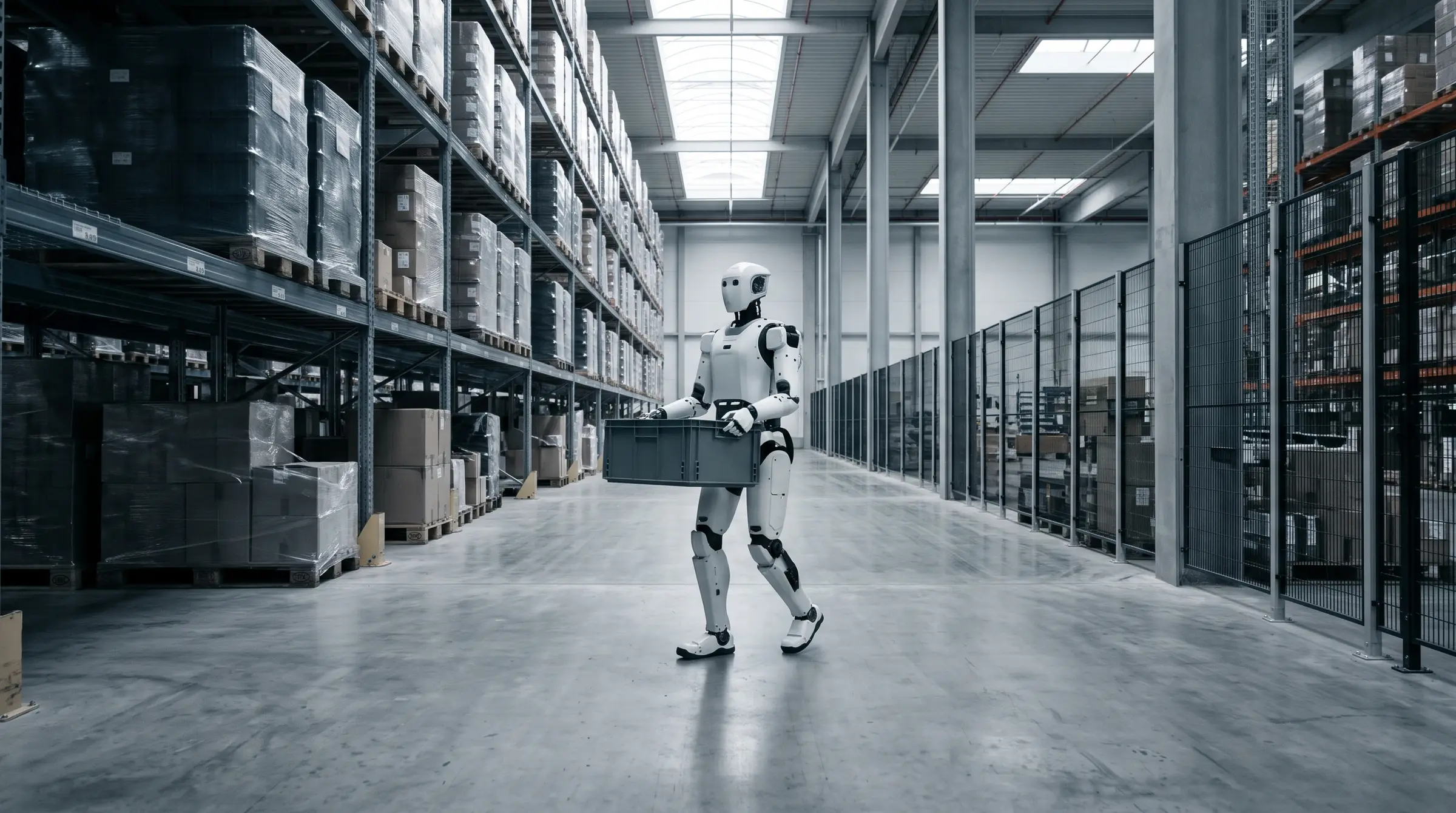
Intralogistics is going through a structural phase of development that puts established concepts of automation to the test. For decades, the automation of logistics properties was shaped mainly by static or rail-guided systems. These technologies often required the building infrastructure to be extensively adapted to the machine. As humanoid robots mature, a paradigm shift is now moving into the focus of real estate economics. These systems are designed to move in environments originally conceived for people. For commercial property this opens up new perspectives: the building no longer necessarily has to be built around the technology, because the technology adapts to the existing architecture. LÈMANS regards this development as a key driver of future discussions on space and of strategic location decisions.
The end of the "dark warehouse" or a new form of coexistence?
For a long time, the theoretical debate on the future of logistics centred on the so-called "dark warehouse". The vision describes fully automated warehouses in which machines operate in darkness, because human needs such as lighting, climate control or wide walkways no longer matter. While such a model maximises space and energy efficiency for standardised processes, it produces highly specialised properties that are difficult to convert when the use changes.
Humanoid robots offer a conceptual alternative. They preserve the human scale of the building. Stairs, conventional racking, standard doors and ordinary workstations remain usable. This "drop-in" capability means that older existing properties, so-called brownfield assets, could enjoy a longer useful life, since they do not necessarily require costly retrofitting to accommodate state-of-the-art automation. The space remains hybrid. It provides a stage for coexistence, with people and machines using the same physical interfaces. From LÈMANS' perspective, this raises the question of whether a property's alternative-use potential will in future be measured by how well it supports such hybrid use.
International perspective: the global dynamics of robotics
Humanoid robotics is developing in a dynamic international environment shaped by different industrial policy approaches. The United States shows a strong focus on combining artificial intelligence with hardware. Companies from the technology and automotive sectors use existing AI infrastructure and training models to accelerate the cognitive capabilities of robots. In parallel, China is driving the scaling of the technology through state framework plans and a dense manufacturing base. Its targets envisage a comprehensive humanoid ecosystem, which is reflected in a high frequency of new model launches.
Market observers and financial institutions project significant growth rates for the global humanoid robotics market, with estimates pointing to a market volume in the hundreds of billions by 2035. Within this global landscape, Europe positions itself mainly through its strengths in precision manufacturing, mechatronics and standard setting. European companies play a major role in developing essential components such as actuators. At the same time, new safety guidelines are being worked on intensively at international level, including within the International Organization for Standardization. Because humanoid robots balance through continuous corrective movements, approving them for open working environments requires an entirely new cross-border consensus on machine safety.
The evolution of building infrastructure: beyond the floor slab
Even though humanoid robots can in theory operate in conventional warehouses, the qualitative requirements for building services are changing. Floor quality, which is paramount for automated guided vehicles, gives way to a more holistic view of infrastructure. Energy supply is a key aspect. Replacing manual labour with electrical systems shifts energy demand. Humanoid robots need continuous charging cycles, which changes the base load of the property. Decentralised charging zones or automated battery-swap systems are becoming part of building design and call for a forward-looking sizing of the local grid connection capacity.
In addition, the logistics property is increasingly becoming an IT hub. The robots' ability to act in unstructured environments rests on processing vast amounts of data in real time. This requires high-performance local networks such as private 5G campus networks, as well as local computing capacity, so-called edge computing. Integrating such systems into a commercial warehouse places new demands on thermal management and indoor climate design, since server infrastructure needs specific ambient conditions. The building thus increasingly acts as a technological enabler that passively supports the sensing and communication of the mobile units.
The socio-technical system and implications for ESG
Integrating humanoid systems into operations inevitably touches on the social dimension of work. Academic literature often refers to the transition to "Industry 5.0", a concept that emphasises synergy between people and machines rather than pure substitution. In this scenario, robots primarily take over repetitive or ergonomically demanding tasks, while people carry out planning, monitoring and corrective work.
For corporate ESG strategies (environmental, social, governance), this development offers room for discussion. On the one hand, ergonomic relief can contribute positively to the social component and change the quality of work in logistics. On the other hand, implementing such systems requires accompanying concepts for staff training and for building trust in machine safety. On the environmental side, the higher demand for electricity raises questions that are ideally addressed by generating renewable energy on site. In this context, the property acts as the physical framework that significantly influences whether these sustainability targets are achieved.
Debate and outlook
The era of humanoid robotics in logistics is only beginning, but the conceptual course is being set today. Reducing automation to a purely financial return-on-investment calculation falls short given the scope of the technology. What is needed is an interdisciplinary dialogue between developers, occupiers, owners and regulators.
The logistics property of the future is increasingly losing its character as a purely functional envelope against the weather. It is evolving into an active, connected and highly adaptable habitat. LÈMANS considers it essential to accompany this transformation objectively and to create room for professional exchange. Location decisions and property valuations will increasingly be shaped by the question of how far a building can serve as a reliable foundation for the complex interplay of human labour and artificial intelligence. The answer to this question will structurally shape the market for industrial and logistics property in the years ahead.