The silent hazard in the after-sales process
In the logistics industry, the first quarter of the year traditionally marks the peak of reverse logistics. After the high-turnover Christmas season, enormous volumes of goods flow back into warehouses. This year, however, the situation is intensified by a significant increase in battery-powered consumer electronics and light electric vehicles (LEVs) such as e-scooters and e-bikes. What is logistically "just" a return is, in terms of fire protection and insurance, a potentially explosive scenario. Unlike in new-goods logistics, the condition of the energy storage device in a return is by definition unknown. A damaged cell, a drop at the customer's home or improper packaging turns the parcel from an ordinary commercial good into dangerous goods. For asset managers and operators of logistics property, this makes it imperative to examine whether the physical fabric of their buildings is suitable for this specific risk profile. If no dedicated incident concepts are built in, the consequence is not only the loss of insurance cover but, in the event of a fire, full contamination and thus the total economic loss of the property.
Actuarial reassessment: from commodity to risk
For a long time, lithium-ion batteries (LIBs) were often treated as standard commodities in property insurance policies, provided they were new and in their original packaging. Those days are over. Driven by major losses and the tightening of guidelines by international insurers (such as FM Global Data Sheet 8-1) and national publications (VdS 3103), a rigorous reassessment is under way. The critical factors are the state of health (SoH) and the state of charge (SoC). While manufacturers of new goods often reduce the SoC to 30 to 50 percent, a level optimised for fire safety, returns often come back fully charged or deeply discharged. A battery of unknown status is a black box for the property insurer, with a high potential for thermal runaway. Insurers are therefore increasingly demanding evidence of physically separated areas designed specifically for the quarantine and inspection of these returns. If this evidence is missing from the fire protection concept, cover for the site is often refused or subject to prohibitive premiums, which effectively makes the property unusable for modern e-commerce tenants.
A structural answer to thermal runaway: the quarantine concept
The core problem with lithium-ion battery fires is thermal runaway, an exothermic chemical reaction in which the cell produces its own oxygen and therefore cannot be reliably stopped by conventional gas extinguishing systems or oxygen reduction. The structural response must allow physical separation and either controlled burn-out or massive cooling. The concept of a dedicated incident area, strictly separated from regular stock, has become established for this purpose.
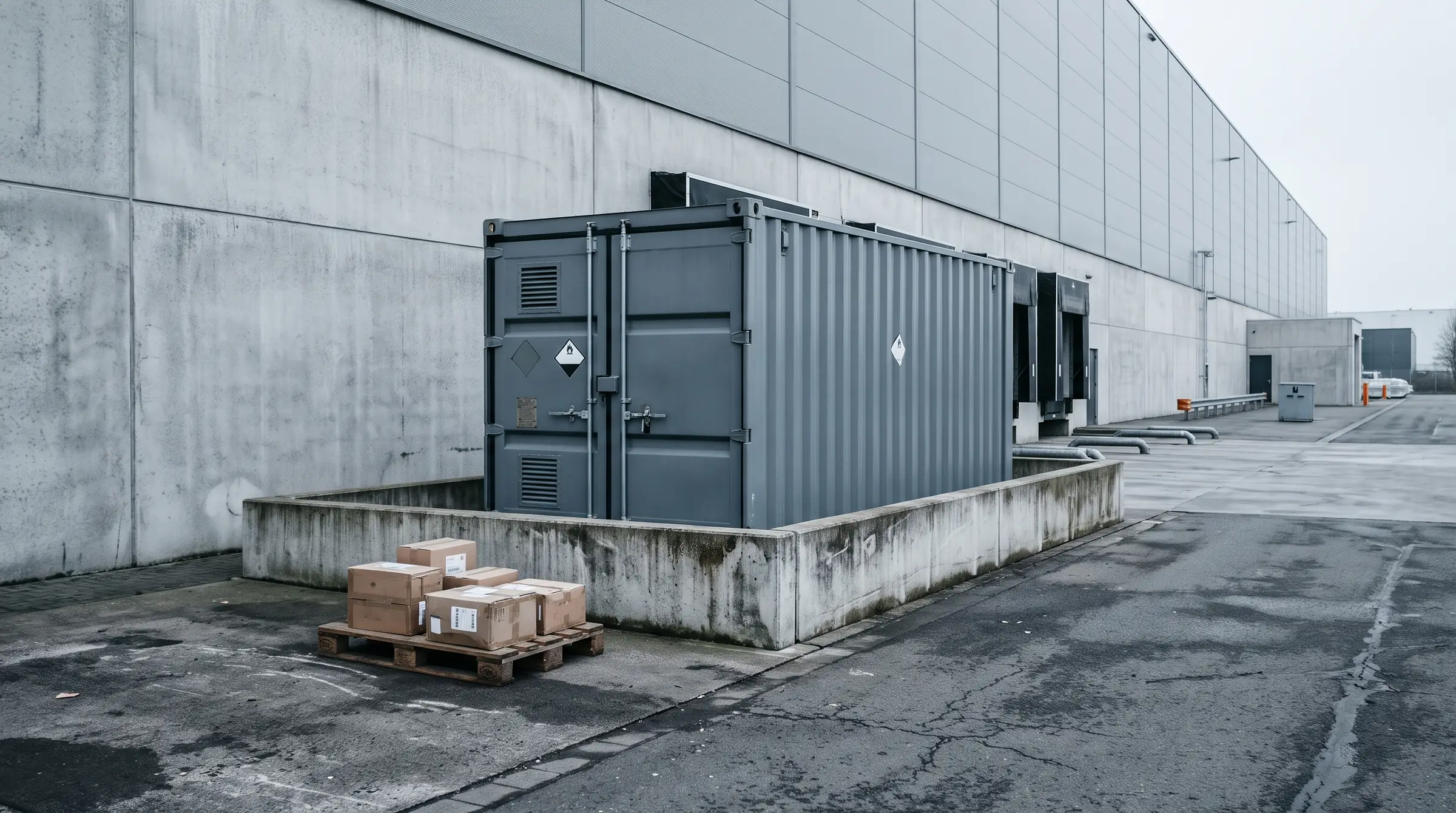
For existing logistics properties, this often means retrofitting is required. Ideally, these risk processes are moved outdoors. Special hazardous materials containers or solid concrete modules with F90 classification (fire-resistant for 90 minutes) are placed at a safe distance from the facade. VdS 3103 often recommends distances of at least five metres to prevent fire from spreading to the main building. For the property operator, this means that outdoor areas can no longer be regarded merely as circulation or parking space, but must be designated as essential technical areas for handling hazardous materials.
If outdoor storage is not possible because of the plot geometry or process flows, a "bunker in the box" concept must be implemented inside the warehouse. This requires a structurally separated fire compartment (at least F90, preferably F180/REI180) with direct pressure relief to the outside. Since burning batteries release toxic and explosive electrolyte gases (including hydrogen fluoride), a connection to a gas-detecting fire alarm system and a powerful mechanical extraction system operating independently of the rest of the building are indispensable. These structural interventions are substantial and affect the structural design and the building envelope, but they are the only way to secure the property's alternative-use potential in the electronics sector.
The underestimated cost trap: firewater retention
An often overlooked aspect in planning safety areas for lithium-ion batteries is the German firewater retention guideline (LöRüRL). Since a lithium fire is fought primarily by cooling, enormous quantities of water are needed in an emergency. On contact with the damaged battery, this firewater becomes contaminated with heavy metals and compounds containing hydrofluoric acid and legally becomes a substance highly hazardous to water. If this mixture enters the soil or the sewer system, the Federal Water Act (WHG) applies, with criminal law implications for the operator.
Structurally, this means that the incident area, whether the outdoor container or the indoor compartment, must be designed as a liquid-tight bund. Conventional industrial floors are often insufficient; WHG-compliant coatings and upstands are required. In particular, automatic firewater barriers must be installed at sectional doors and transitions to the rest of the warehouse, closing in the event of an alarm and retaining the contaminated water within the fire compartment. For existing properties, retrofitting such retention volumes is often the largest cost driver, since lowering the floor or installing underground retention tanks is frequently necessary to provide the required cubic metres of retention capacity.
Integration into the operational workflow
From the occupier's perspective, the property must integrate this safety architecture seamlessly into the returns intake process. The unknown status only ends after a qualified inspection. Until then, the parcel must not leave the secured area. A property that cannot accommodate this loop structurally, for instance because the route from goods-in to the incident area passes through the main warehouse, creates operational inefficiencies. Modern logistics layouts therefore position the returns inspection area close to the loading docks, but separated by fire walls, with direct access to the incident container. In the due diligence of logistics assets, investors should therefore specifically examine whether the building services and the layout allow such compartments to be formed without having to recalculate the sprinkler hydraulics from scratch.
Strategic conclusion
The wave of returns of battery-powered electronics is not a temporary phenomenon but a structural market trend that permanently changes the requirements for logistics property. The fire risk posed by damaged lithium-ion batteries forces investors and asset managers to regard fire protection no longer as a mere compliance task, but as an asset protection strategy.
For investors, this means: review your portfolio for "lithium readiness". Assets without outdoor space for incident containers, or without the option of forming small, highly fire-resistant compartments, risk a brown discount, because they are unsuitable for a growing group of tenants with strong covenants in e-commerce, automotive and electronics. Budget capex for firewater barriers and WHG coatings in your hold strategies.
For occupiers: define the returns inspection step as a critical path in the lease. Insist on structural standards that comply with VdS 3103 and your insurer's requirements before signing the lease. Retrofitting during ongoing operations almost always causes major disruption to intralogistics.